Methodology
The foundation
Over thirty years of science and practice.
The models are the result of our own methodology, developed over more than thirty years, and they rest on scientific research, on long-standing practice and on business methodologies tested in real work.
What holds them up is repetition: the same questions, asked in different industries and in different years, and the feedback of the people who lead those organisations. That is why the claims in the report are about a model that has been wrong and has been corrected, not about a model that was made up.
What it rests on
Three facts make the result a foundation for a management conversation.
Concept, model and instrument
Every one of the product solutions began as a concept that we created and set out in writing. On it we built a complete practical model whose first aim is to bring value to the people who use it. We stand behind every model and instrument that reaches you with our name, our scientific work, our mathematical models and our results.
Direct testing in real conditions
The instruments have been tested through long-term longitudinal studies in different industries, in professional settings, with direct feedback from managers and employees in the companies. Not in laboratory conditions and not on a single sample.
Elements, not a single number
Each model is read through its own component parts. Labels tied to a single value are not offered, because profiles are looked at as a whole, with their internal interconnections. That is exactly what turns the result into a conversation.
Cadence
When does it make sense to measure again?
Team Intelligence Model®
Every six months. A team needs that much time to apply what it chose and for the new practices to show in real work.
Loyalty Quotient to Loyalty®
Twice in the first year, then once a year depending on the role. In the first year, the purposeful development of both sides is followed from one visible baseline against the same measures; after that, the development and the deviations are followed.
Leadership Self-Awareness®
Every six to twelve months, depending on the goal. Leadership self-awareness changes more slowly than team dynamics, because it is the self-awareness and behaviour of one person, and faster than organisational culture, because the leader can be the catalyst for changing it.
Published
The models are set out beyond the platform as well.
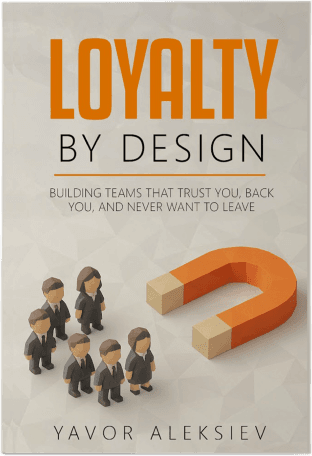
Loyalty Quotient to Loyalty® is described in detail in a book. Team Intelligence Model® is next.